

A science-fiction notebook becomes useful when it tells you what you know, what you still need to investigate and what you have deliberately invented. Without those distinctions, a striking sentence from a video can quietly become a fact in your story. Later, you may struggle to tell whether a problem comes from the research, the plot or the rules of your imaginary world.
You do not need to complete a science degree before writing. You need a small, traceable record that supports the scenes you want to build. Start with one story question, then keep the evidence and the invention visible as separate entries.
Begin with a scene-sized question
“How does the brain work?” is too large for a useful first search. “What would a character need to measure before claiming that a signal changed?” is more manageable. It points toward an instrument, a sample and an observation. Those details can make a scene convincing without requiring a lecture about the entire nervous system.
Write the question above the scene outline. Under it, list what the reader actually needs to understand. Perhaps the character sees a pattern, proposes an explanation and then discovers that the measurement has another interpretation. Research should help that sequence happen clearly; it need not supply every fact you encounter.
Give each note a status
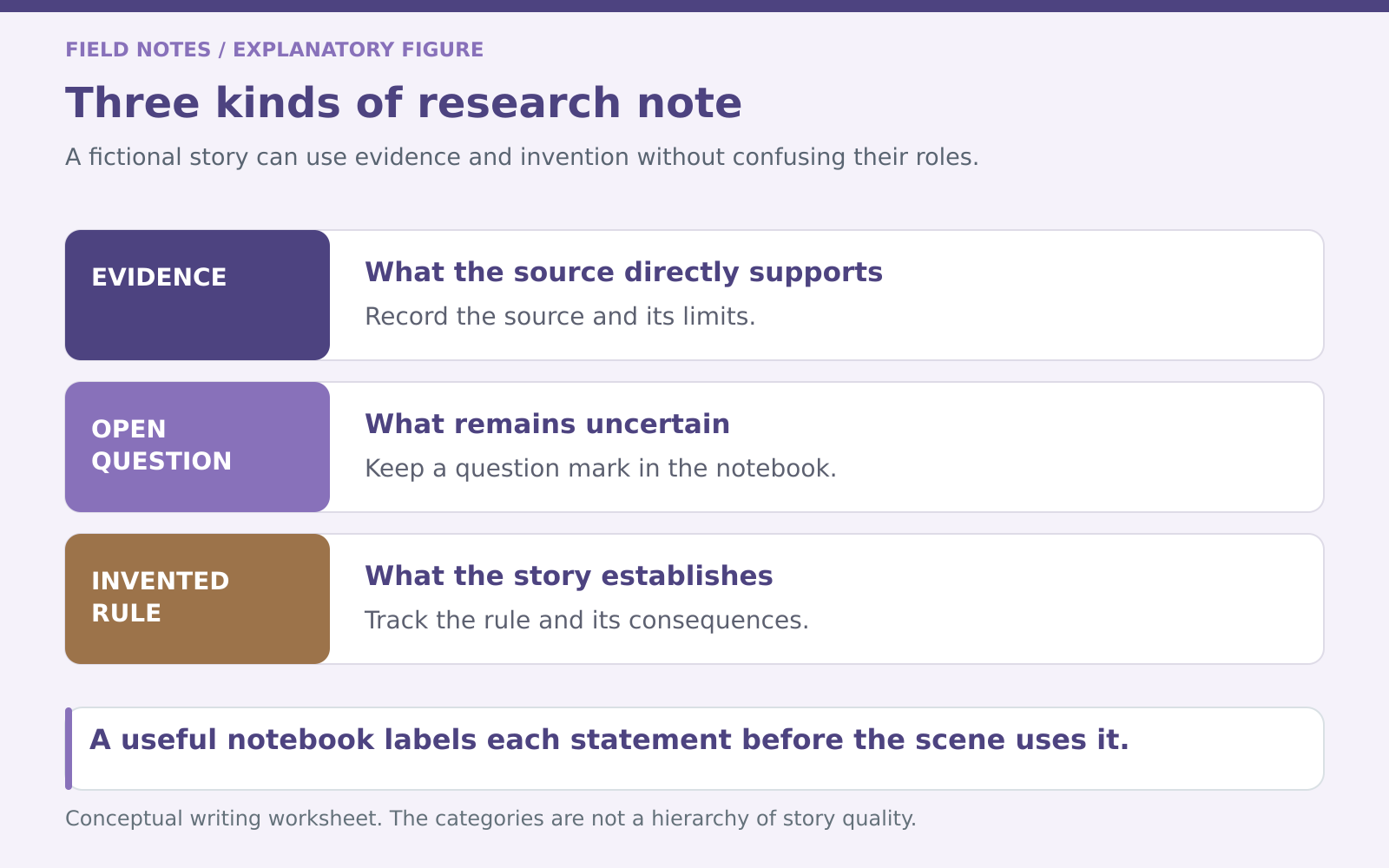
Use three labels: supported fact, open question and invented rule. A supported fact needs a source and a description of its scope. An open question records something you have not settled. An invented rule belongs to the story world, even when real science inspired it. These labels are working tools rather than permanent judgments.
| Notebook label | What belongs in the entry |
|---|---|
| Supported fact | A specific statement, its source and the relevant conditions |
| Open question | What remains unclear and what information would help |
| Invented rule | What your fictional world allows and what limits apply |
For example, a fictional scanner that reads a person’s complete memories is an invented device. Calling it a molecular scanner does not turn that ability into established biology. You can still use it, but its capabilities and limits should come from your world-building notes.
Keep the source beside the statement
Record the page title, author or institution, date when available and a working address. Add a sentence explaining what the source actually supports. This saves time when you return to the draft and prevents a general educational page from becoming evidence for an extremely specific claim.
NASA’s science-fiction journal activity offers an example of combining factual research with an invented journey. Its classroom exercise concerns planetary exploration. The useful writing principle is to identify the factual material inside the fiction, not to assume that every imagined future development has already been demonstrated.
Separate a quotation from your own explanation
A notebook can contain a short quotation, a paraphrase and a scene idea, but they should not look identical. Put quotation marks around copied words and keep the source attached. Write your own explanation on a different line. Then place the fictional application under its own heading.
Suppose a paper describes a receptor in cultured cells. Your factual note concerns that experimental system. Your paraphrase explains the result in simpler language. Your scene idea might involve a fictional researcher making a discovery. The scene can be imaginative without being presented as something that happened in the cited experiment.
Make the invented rule testable within the story
Fictional rules become easier to maintain when they have boundaries. If a device detects one particular signal, decide what happens when the signal is absent, when the sample is contaminated or when a different signal looks similar. These choices create obstacles and opportunities for the characters.
Write one positive example and one failure example for each major invention. A scanner might identify a molecule in a prepared sample but fail in a complex mixture. That limitation can matter to the plot. It also makes the fictional technology feel less like an unlimited answer machine.
Use analogies without allowing them to take over
A biological signal might be compared with a message, and a receptor with a receiver. The comparison helps a reader enter the subject, but molecules do not read sentences or intend to communicate an emotion. Keep a second note explaining where the analogy stops being accurate.
ESA’s lesson comparing science fiction with science fact illustrates the value of examining both together. For your own notebook, make a similar two-column comparison: what the analogy makes clear, and what it leaves out. The second column often supplies the detail that improves a scene.
Build a small continuity check
Before drafting a new chapter, reread the invented rules already used. Does the device still require the same sample? Does it take the same amount of time? Has a character suddenly gained information that the earlier method could not provide? A changed rule can be part of the plot, but the change needs an explanation.
You can use a simple scene ledger. Give each scene a number, list the scientific idea involved and note whether the scene uses evidence, uncertainty or invention. If three scenes depend on one unsupported assumption, the ledger shows where a revision would have the greatest effect.
Track the consequence of one invented exception
Suppose your fictional messenger can carry information across a sealed door. Record what the exception changes and what it leaves untouched. Can the receiver identify the sender? Can two messages arrive together? Does distance change the delay? These are continuity questions, not claims about existing technology.
Choose one consequence to test in a short scene. If a character receives an anonymous warning, the scene can explore the uncertainty of its source without adding another invention. A narrow rule often generates more convincing tension than a device that gains a new ability whenever the plot becomes difficult. Keep abandoned versions in a separate note so that an earlier draft does not quietly reintroduce them.
Finish a research session with a decision
A productive session should change the draft or clarify the next question. Write a brief closing note: keep the scene, revise the measurement, make the technology explicitly fictional, or investigate a narrower point. This turns research into an editing process instead of an endless collection of interesting tabs.
The notebook is not an examination of how much science you can remember. It is a map of the relationship between your story and its evidence. When that map is clear, you can invent boldly while remaining precise about which parts belong to the world outside the page.